

Table of Contents
- Introduction
- When Principles Meet Personal Interest
- The Psychology Behind Our Decisions
- Everyday Examples
- Integrity Is Tested During Loss
- The Cost of Compromising
- A Better Question to Ask
- Frequently Asked Questions
“Character is not revealed when doing the right thing is easy. It is revealed when doing the right thing comes at a personal cost.”
Introduction
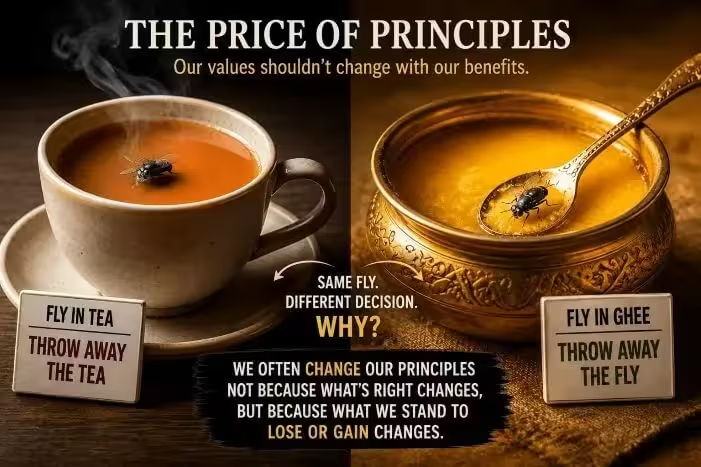
The fly in the tea is a simple story with a much bigger lesson underneath it. Imagine this situation: a fly falls into a cup of tea. Most people would immediately throw away the tea because it is no longer safe or appealing to drink.
Now imagine a fly falls into a large pot of pure ghee. Surprisingly, many people would simply remove the fly and continue using the ghee.
The difference is striking. In one case, we discard the entire product. In the other, we save it by removing only the contaminant.
At first glance, this may seem like an ordinary everyday decision. But beneath it lies a profound lesson about human behavior. Our choices are often influenced not only by principles but also by what we stand to lose.
When Principles Meet Personal Interest
We like to believe that our values are fixed — that honesty, fairness, and integrity guide every decision we make. Yet reality often tells a different story.
When the cost of following our principles is small, we proudly defend them. But when those same principles threaten our money, comfort, reputation, or success, many people begin searching for exceptions.
The principle itself hasn’t changed. Only the price of following it has. This is one of the most common contradictions in human nature — and it’s exactly what the fly in the tea is really about.
The Psychology Behind Our Decisions
Behavioral psychologists have long observed that people tend to fear losses more than they value equivalent gains. This tendency, often called loss aversion, influences countless everyday decisions.
When a cup of tea is spoiled, replacing it feels inexpensive. Throwing it away seems reasonable. A pot of ghee, however, represents a much greater financial loss. Suddenly, our thinking changes. Instead of asking, “What is the right thing to do?” we begin asking, “How much will this cost me?”
Without realizing it, our priorities shift.
Everyday Examples
This pattern appears everywhere in life.
- A company proudly advertises its commitment to ethics — until profits begin to decline.
- An employee values honesty — until admitting a mistake could cost a promotion.
- A friend believes in loyalty — until supporting someone becomes inconvenient.
- A customer demands fairness — until bending the rules benefits them personally.
These situations rarely begin with bad intentions. They begin with small compromises that seem harmless. Over time, those compromises reshape character.
Integrity Is Tested During Loss
Anyone can claim to have strong principles when there is nothing at stake. Real integrity appears when keeping those principles requires sacrifice.
- Honesty matters most when lying would be easier.
- Fairness matters most when being unfair would be profitable.
- Loyalty matters most when walking away would be convenient.
Our values are not measured by our words but by our actions when those values become expensive.
The Cost of Compromising
Compromising principles may provide temporary benefits, but it often comes with hidden costs.
- Trust takes years to build and only moments to lose.
- A damaged reputation is difficult to restore.
- Relationships weaken when people realize that convenience matters more than commitment.
In the long run, integrity creates opportunities that shortcuts never can. If you’re working on building better daily habits alongside stronger principles, our guide on using AI to boost daily productivity is worth a read.
A Better Question to Ask
Instead of asking, “What can I gain?” — perhaps we should ask, “Will I still be proud of this decision years from now?”
That single question has the power to transform how we make decisions in business, relationships, and everyday life.
Conclusion
The story of the fly in the tea and the fly in the ghee is not really about food. It is about us.
It reminds us that our principles often face their greatest challenge when profit, convenience, or personal interest enters the equation. True character is not defined by what we say we believe. It is defined by what we choose when those beliefs come with a cost.
Because in the end, principles have value only when we refuse to sell them for convenience — and that is the real lesson behind the fly in the tea.
Frequently Asked Questions
What does the story of the fly in the tea mean?
It’s a metaphor for how people apply their principles inconsistently, discarding something entirely when the loss feels small, but making exceptions when the stakes are higher.
What is loss aversion?
Loss aversion is a psychological concept describing how people tend to feel the pain of a loss more strongly than the pleasure of an equivalent gain, which often shapes how they make decisions under pressure.
How can I stay consistent with my principles under pressure?
Try asking yourself whether you’d still be proud of a decision years from now, rather than focusing only on what you stand to gain in the moment.