
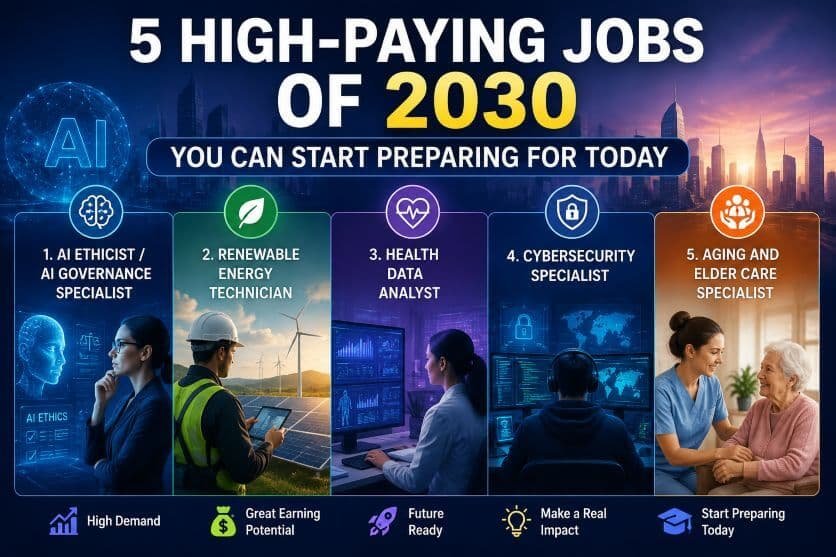
5 High-Paying Jobs of 2030 You Can Start Preparing For Today

Table of Contents
- Why These Jobs Are Worth Watching
- 1. Shape the Rules as an AI Governance Specialist
- 2. Power the Grid as a Renewable Energy Technician
- 3. Turn Data Into Care as a Health Data Analyst
- 4. Defend Systems as a Cybersecurity Specialist
- 5. Guide Families as an Aging and Elder Care Specialist
- Key Takeaways
- How to Start Preparing Today
- Frequently Asked Questions
- Sources & Further Reading
If you're curious about the high-paying jobs of 2030, the good news is that many of them are already taking shape right now — driven by shifts in technology, energy, healthcare, and demographics. You don't need to wait for the future to arrive to start preparing for it. Here are five emerging roles worth watching, what they realistically pay today, and how you can begin building relevant skills right now.
Why These Jobs Are Worth Watching
Every major shift in technology and society creates new categories of work. The rise of AI, the push toward renewable energy, an aging global population, and growing concerns around data and cybersecurity are all reshaping what "in-demand" will mean over the next several years. Many of the high-paying jobs of 2030 will sit at the intersection of these trends — combining technical skills with judgment, ethics, or care that machines alone can't provide.
1. Shape the Rules as an AI Governance Specialist
As AI systems take on more responsibility in hiring, healthcare, finance, and law enforcement, organizations increasingly need people who can evaluate whether these systems are fair, transparent, and compliant with emerging regulations like the EU AI Act. AI governance specialists and AI ethicists help companies navigate this responsibly, often working closely with legal, product, and engineering teams.
Typical pay: Entry-level roles (AI Ethics Officer, AI Policy Analyst) often start around $80,000–$108,000, with industry-wide averages closer to $141,000–$152,000, and senior or director-level roles reaching $190,000 or more, according to recent salary surveys from ZipRecruiter and the IAPP.
Skills you'll need: Familiarity with AI ethics frameworks, risk assessment, and policy analysis; a certification like IAPP's AIGP (Artificial Intelligence Governance Professional) is increasingly valued. If you're already exploring how AI tools work, our guide on using ChatGPT step by step is a good starting point for building foundational AI literacy.
2. Power the Grid as a Renewable Energy Technician
As countries continue investing in solar, wind, and battery storage infrastructure, skilled technicians who can install, maintain, and troubleshoot renewable energy systems are in growing demand. According to the IRENA and ILO Renewable Energy and Jobs Annual Review 2025, global renewable energy employment has reached at least 16.6 million jobs and continues to grow.
Typical pay: Unlike some other roles on this list, this is a more accessible, entry-friendly path rather than a guaranteed six-figure one. Entry-level technicians typically earn $44,000–$55,000, with the national median closer to $60,000–$62,000. Experienced and certified technicians, especially in offshore wind or specialized solar installation, can reach $90,000–$115,000+.
Skills you'll need: Electrical and mechanical aptitude, safety certifications, and hands-on training. This field often doesn't require a four-year degree — a certification such as NABCEP (for solar) can open doors relatively quickly.
It may not be the highest earner among the high-paying jobs of 2030, but it remains one of the most accessible.
3. Turn Data Into Care as a Health Data Analyst
Healthcare systems are generating enormous amounts of data, from electronic health records to wearable device metrics. Health data analysts help hospitals, insurers, and research organizations turn that data into better patient outcomes and more efficient operations.
Typical pay: Entry-level analysts (0-2 years) typically earn $65,000–$78,000. Mid-career analysts with 3-7 years of experience and strong SQL/BI skills average $88,000–$98,000, while senior analysts with healthcare domain expertise can reach $115,000–$145,000.
Skills you'll need: SQL, data visualization tools (like Tableau or Power BI), and healthcare domain knowledge. A CHDA (Certified Health Data Analyst) credential from AHIMA can help you stand out.
Among the high-paying jobs of 2030, this one rewards steady, methodical skill-building over flashy credentials.
4. Defend Systems as a Cybersecurity Specialist
As more of daily life moves online, the need to protect systems, data, and infrastructure from cyber threats continues to intensify. Cybersecurity specialists are consistently listed among high-demand, well-compensated roles, and the shortage of qualified professionals in this field is well documented across the industry, according to the ISC2 Cybersecurity Workforce Study.
Typical pay: The U.S. Bureau of Labor Statistics reports a median annual wage of $124,910 for information security analysts (May 2024 data). Entry-level roles typically start at $65,000–$85,000, mid-level engineers and analysts earn $90,000–$148,000, and senior architects or CISOs can exceed $200,000.
Skills you'll need: Foundational certifications like CompTIA Security+ are a common entry point, with more advanced credentials (CISSP, CEH) opening doors to senior roles. Most senior cybersecurity roles screen on certifications and demonstrable experience rather than formal education alone.
Of all the high-paying jobs of 2030 on this list, cybersecurity currently offers the clearest, most well-documented demand.
5. Guide Families as an Aging and Elder Care Specialist
With life expectancy rising in many parts of the world, there's growing demand for professionals who specialize in elder care planning, geriatric care management, and age-related healthcare services — coordinating care, navigating benefits, and supporting families through difficult transitions.
Typical pay: Geriatric care managers earn an average of roughly $88,000–$95,000 per year, with entry-level roles closer to $56,000–$66,000 and experienced, credentialed professionals in high-demand metro areas reaching $124,000–$146,000.
Skills you'll need: A background in social work, nursing, or healthcare administration is common, along with strong communication and care-coordination skills. The Aging Life Care Association's CMC (Care Manager Certified) credential is a recognized standard in the field.
This is one of the more people-centered high-paying jobs of 2030, rewarding empathy as much as expertise.
Key Takeaways
Here's a quick summary of the high-paying jobs of 2030 covered in this guide:
- ✅ AI governance is one of the fastest-growing, highest-paying emerging fields, with average pay already above $140,000.
- ✅ Renewable energy technician roles offer an accessible, certification-based entry point, though pay is more modest than the other roles on this list.
- ✅ Health data analysis rewards SQL and healthcare domain expertise, with strong mid-career growth.
- ✅ Cybersecurity remains one of the most consistently well-paying tech fields, driven by a persistent global talent shortage.
- ✅ Elder care specialists are in growing demand as populations age, offering steady, people-centered work.
- ✅ No job here guarantees six figures automatically — experience, certification, and location all significantly affect actual pay.
How to Start Preparing Today
Whichever of the high-paying jobs of 2030 catches your interest, these steps apply broadly:
- Build foundational digital literacy. Regardless of which field you're drawn to, comfort with data tools, AI assistants, and basic tech systems will help in almost any of the high-paying jobs of 2030.
- Look into certifications, not just degrees. Many emerging fields, especially renewable energy and cybersecurity, offer accessible certification paths that don't require a traditional four-year degree.
- Follow the underlying trend, not just the job title. Job titles will keep evolving, but the underlying trends — AI governance, clean energy, healthcare data, cybersecurity, and aging populations — are likely to stay relevant for years.
- Start small and stay consistent. You don't need to switch careers overnight. Small, steady steps — a course here, a certification there — add up significantly over a few years.
Frequently Asked Questions
Do I need a college degree for these jobs?
Not necessarily. Fields like renewable energy and cybersecurity often offer certification-based entry points into the high-paying jobs of 2030, while others, like AI governance or health data analysis, may benefit from a relevant degree combined with specialized training.
Are these jobs guaranteed to pay six figures?
No single job guarantees a specific salary — pay varies by location, experience, employer, and demand. These roles are highlighted because they sit in growing fields with strong long-term earning potential, and several of them already average six figures, but that isn't guaranteed for every entry-level hire.
How can I start preparing without quitting my current job?
Many of these fields offer part-time courses, online certifications, and evening programs specifically designed for working professionals looking to transition gradually.
Which of these jobs is best for beginners?
Cybersecurity and renewable energy tend to offer the most accessible entry points, through certifications like CompTIA Security+ or NABCEP, without requiring years of prior specialized experience. AI governance and health data analysis typically reward candidates who already bring some technical or policy background.
The careers of tomorrow are already taking shape today. Whether you're a student, a working professional, or someone considering a career change, the best investment you can make is in future-ready skills. You don't need to predict the future perfectly — you simply need to start preparing before everyone else does.
Sources & Further Reading
The salary data referenced throughout this guide to the high-paying jobs of 2030 comes from the following sources:
- U.S. Bureau of Labor Statistics, Occupational Employment and Wage Statistics (Information Security Analysts, May 2024)
- ISC2 Cybersecurity Workforce Study
- IRENA & ILO, Renewable Energy and Jobs: Annual Review 2025
- IAPP AI Governance Profession Report and Salary Survey, 2025-2026