
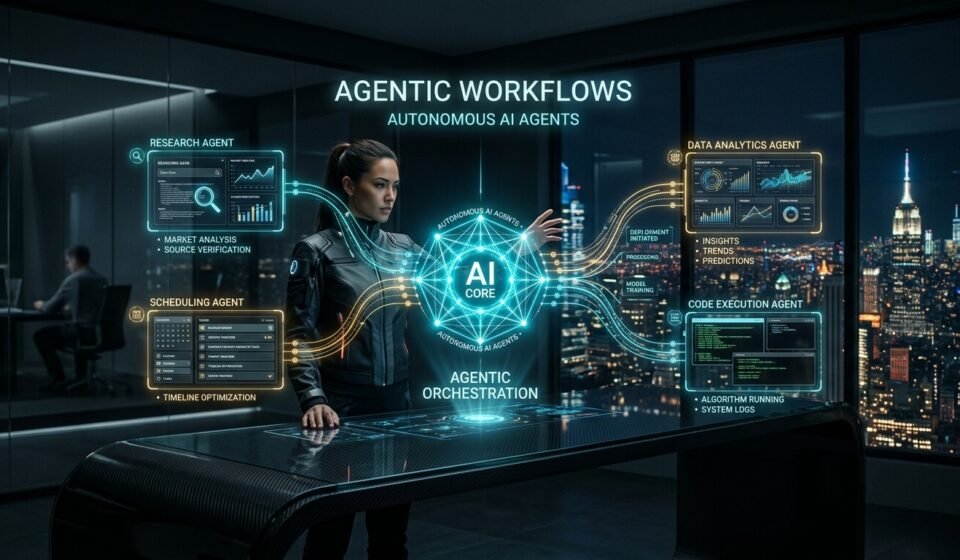
The Rise of Autonomous AI Agents in 2026: How ‘Agentic Workflows’ Are Reshaping Everyday Work

Table of Contents
- Chatbots vs. AI Agents: What Actually Changed?
- The 4 Core Pillars of an Agentic Workflow
- 5 Real-World Ways AI Agents Are Transforming Work Today
- Why Multi-Agent Collaboration Is the Real Breakthrough
- The Human-in-the-Loop Imperative: Governance & Safety
- How Beginners Can Start Using Agentic AI Without Coding
- Key Takeaways
- Frequently Asked Questions (FAQ)
For the past three years, our relationship with Artificial Intelligence has followed a familiar script: you open a chat box, type a prompt, wait for a response, and then copy-paste that text into another app to actually get the job done.
In 2026, that paradigm is rapidly becoming obsolete.
We have officially entered the era of Autonomous AI Agents and Agentic Workflows. Instead of passive chatbots that merely talk about work, modern AI systems can now plan, execute, verify, and complete multi-step tasks across different software tools with minimal human hand-holding.
If you want to understand where technology is heading next—and how to position yourself ahead of the curve—here is your complete guide to the rise of Agentic AI in 2026.
Chatbots vs. AI Agents: What Actually Changed?
To grasp why tech leaders are calling 2026 the "Year of the Agent," it helps to understand the fundamental difference between a traditional Large Language Model (LLM) chatbot and an Autonomous AI Agent:
- A Chatbot is an Advisor: If you ask a chatbot, "Help me plan a client webinar," it gives you a bulleted checklist. You still have to create the calendar invites, draft the landing page, and set up the emails manually.
- An AI Agent is an Executor: If you give an AI agent the same goal, it breaks the objective into sub-tasks, checks your calendar availability, drafts the registration page in your CMS, prepares the email drafts in your marketing tool, and asks for your final "Approve" click.
Related Reading: New to foundational AI prompting? Start with our beginner's guide on how to use ChatGPT step-by-step before diving into multi-step automation.
The 4 Core Pillars of an Agentic Workflow
Leading AI researchers have highlighted that agentic workflows often outperform even the largest raw models because they mimic how humans actually work. Every capable AI agent relies on four building blocks:
- Perception & Context Ingestion: The agent reads live inputs—whether that’s an incoming customer ticket, a spreadsheet update, or a set of research PDFs.
- Planning & Decomposition: Instead of rushing to an answer, the agent breaks a complex goal into logical steps and adapts if a step fails.
- Tool Use & Action Execution: Modern agents can browse live websites, run scripts, query databases, and update records across platforms like Slack, Notion, and Google Workspace.
- Self-Reflection & Verification: Before showing you the final work, an agentic system critiques and verifies its own output against your rules.
5 Real-World Ways AI Agents Are Transforming Work Today
Autonomous agents are no longer confined to research labs. Here is how professionals are deploying them right now:
- Autonomous Research & Competitive Intelligence: Agents continuously monitor industry news and academic preprints, compiling a verified weekly briefing doc. (For document-grounded synthesis, also check our Ultimate Guide to Google NotebookLM in 2026).
- End-to-End Software Engineering: Coding agents read issues, locate bugs across files, write unit tests, verify fixes, and submit pull requests.
- Smart Financial & Data Auditing: Agents scan thousands of records, cross-check them against logs, and flag anomalies for human review.
- Personalized Learning Tutors: Adaptive agents track a learner's weak spots over time, generating custom practice modules tailored to their pace.
- Inbox & Calendar Triage: Personal executive agents coordinate meetings across time zones and prepare pre-meeting dossiers.
To see how these workflows fit into a personal time-saving system, explore The 2026 AI Productivity Blueprint.
Why Multi-Agent Collaboration Is the Real Breakthrough
The biggest architectural shift in 2026 is Multi-Agent Orchestration—creating a small digital team where specialized agents collaborate:
- Agent A (The Researcher): Gathers verified facts, statistics, and source links.
- Agent B (The Strategist): Organizes the findings into a structured narrative and business case.
- Agent C (The Critic / Auditor): Fact-checks every claim against original sources and checks for compliance risks.
When specialized agents review each other's work, accuracy skyrockets while hallucinations drop dramatically.
The Human-in-the-Loop Imperative: Governance & Safety
An agent with unrestricted access could accidentally send an unapproved email or modify critical records. That is why Human-in-the-Loop (HITL) governance is non-negotiable.
Let agents read and draft autonomously, but require explicit human approval before sending external communications or executing financial transactions. As we detailed in our analysis of The AI-Proof Skillset for 2026–2030, ethical accountability, strategic taste, and emotional empathy remain 100% human responsibilities.
How Beginners Can Start Using Agentic AI Without Coding
- Map One Repetitive Process: Pick a recurring weekly task that follows predictable rules.
- Use No-Code Agent Builders: Platforms like Zapier Central, Make, and built-in workspace agents allow you to build multi-step agents using plain English instructions.
- Start in "Draft Mode": Run your agent in draft-only mode first. Review its decisions, refine its instructions, and expand its scope once it proves reliable.
Remember, the goal of automation isn't to fill your schedule with more frantic busywork—it is to free your mind from the trap of false urgency so you can focus on deep, meaningful creation.
Key Takeaways
- 🤖 From Talkers to Doers: AI in 2026 has evolved from passive chatbots into proactive agents capable of multi-step planning and tool execution.
- 🔄 Iterative Self-Correction: Agentic workflows achieve higher quality by planning, acting, reflecting, and verifying their own outputs.
- 👥 Multi-Agent Teams: Combining specialized agents (Researcher + Writer + Critic) produces far better results than relying on a single mega-prompt.
- 🛡️ Human-in-the-Loop Control: Always keep human approval checkpoints on high-stakes actions.
Frequently Asked Questions (FAQ)
Are autonomous AI agents safe to connect to my personal or work accounts?
Yes, provided you follow the principle of least privilege. Only grant agents access to the specific folders or tools they need, and always configure "Ask for confirmation" before any external action is executed.
Do I need to know Python or programming to build AI agents?
Not anymore. While developers use code frameworks, non-technical professionals can build powerful autonomous workflows using no-code visual platforms and natural language instructions.
Will AI agents replace project managers and knowledge workers?
Rather than replacing knowledge workers outright, AI agents turn every individual professional into a "manager of digital agents." Those who learn to orchestrate and audit agentic workflows will dramatically outperform those who work manually.
Stay Ahead. Stay Informed.
Join our community and be the first to receive our latest insights on AI breakthroughs, productivity, and modern career blueprints.
Subscribe to Newsletter